The Journal / Brand development
Paris Garment Workshop: 7 Steps to Produce Your Small Run Close to Home
From brief to quality control, the 7 steps to entrust your small run to a garment workshop in Paris or Île-de-France.
November 21, 2026 6 min read By the D'YRSAN workshop

Finding a Paris garment workshop able to produce a small quantity is often the first real headache for a designer launching her brand. Large factories demand volumes you do not yet have, and independent seamstresses do not always have a design office to make your patterns reliable. In between, there are workshops in the Paris region built for small series, provided you know how to work with them.
At D'YRSAN, in Asnières-sur-Seine, we support swimwear, lingerie and ready-to-wear brands from the first sketch through to production. Here are the 7 steps that we recommend for producing close to home, with peace of mind and no waste. These points apply to our workshop as to any garment manufacturer you consult.
Why produce with a Paris garment workshop?
Proximity is not just a communication argument. A sewing workshop in Île-de-France lets you come to fittings, touch the materials and correct a detail in an afternoon rather than through several parcel exchanges. For a young brand, these quick back-and-forths avoid costly errors across an entire run.
Small quantities also call for a different way of producing. A small-run textile production demand flexibility: more artisanal cutting, machine settings adapted to each model, piece-by-piece tracking. A Paris garment workshop used to these volumes can absorb this complexity without treating it as an exception.
Finally, producing locally makes traceability easier. You know who sews your pieces and under what conditions, and you can tell your customers the facts. It is a pillar of our approach to responsible production, and a true brand argument when you can prove it.
Steps 1 and 2: framing your project before the first meeting
Step 1: write a precise brief
A good brief saves weeks. Gather your sketches, your inspiration photos, the reference garments you love to wear, and note for each model its use, its target and the intended selling price. This is exactly what a workshop needs to answer a request a quote fair and reasoned.
Also state your quantity per model and per size, even approximate. A workshop does not organize thirty pieces of a single model the same way as thirty pieces spread across six styles in five sizes.
Step 2: choose and source your materials
The fabric shapes everything: pattern making, assembly, machines and even the final cost. For a swimsuit, check the ’stretch in both directions and chlorine resistance; for a blouse, the drape and the sheerness. Always order a test length before committing to a full roll.
Think about notions too: elastic, underwires, snaps, thread, labels. You will find some of them in our online haberdashery, which simplifies the prototypes and small runs when wholesalers' minimums are too high for you.
Steps 3 and 4: from pattern to validated prototype
Step 3: have the pattern making done
The pattern is the foundation of your collection. Drafted by a pattern maker, it turns your sketch into flat pieces, with the seam allowances, the notches and the ease suited to the fabric. An approximate pattern costs you later on every piece produced.
Ask for a pattern drafted in your base size, in a format you can retrieve. It will follow you if you ever change garment manufacturer. Our bureau d’études works in this spirit, with pattern making and prototyping under the same roof.
Step 4: test and correct the prototype
A prototype must be judged worn, never only on a hanger. Have it tried on by someone in your base size, and check the tension, creases and comfort in motion. Plan for several back-and-forth rounds before approval, especially in lingerie and swimwear where every millimeter counts.
Write down every correction and keep the approved prototype : it serves as the reference throughout production. Without this reference piece, it is impossible to objectively check the conformity of the run.
Steps 5 and 6: grading, pre-series and production
Step 5: grade and prepare the tech pack
Grading extends the base pattern across all your sizes. It follows grading rules specific to each garment type: a bra cup is not graded like a jacket sleeve. Have at least the smallest and the largest size tried on.
Meanwhile, the workshop establishes the tech pack : material bill, assembly sequence, stitch types, label placement, measurement chart with tolerances. This document avoids misinterpretation and secures every piece.
Step 6: launch the pre-production run, then production
For a small run, a pre-production run of a few pieces per size remains an excellent investment. It reveals assembly difficulties, actual fabric consumption and any differences between sizes. You correct things before the error multiplies.
Next comes production: marker placement and cutting, assembly, finishing, pressing. A specialized Paris sewing workshop adapts its machines to your materials, whether it is swimsuits in stretch knit, of lingerie and corsetry or ready-to-wear in warp and weft woven fabric.
Step 7: inspect, deliver and capitalize
Quality control is based on the validated prototype and the tech pack. We check the key measurements within tolerances, the consistency of seams, the finishes and the cleanliness of the pieces. Ask the workshop how it spots defects and how they are corrected.
On receipt, carry out your own check by sampling : a few pieces per size and per color, measured and fitted. Report any deviation quickly and in writing, with photos.
Finally, keep a record of everything: corrected patterns, tech packs, actual material consumption, feedback from your customers. This production file will make your restocking smoother and will help you evolve your designs from one season to the next. Plan a review with the workshop after each run.
How to choose the right Paris garment workshop: the key criteria
Not every workshop suits a young brand. Before committing, ask concrete questions and compare the answers rather than unit prices alone.
- Specialty : does the workshop master your category? Stretch knitwear, lingerie and tailoring require different machines and different techniques.
- Minimum orders : are they clearly stated per model, per color and per size?
- Integrated design office : pattern, prototype and production in the same place limit the loss of information.
- Transparent quote : prototyping, grading, pre-production and production should appear separately.
- Visits possible: a workshop that opens its doors shows you how it works.
A good textile sewing workshop for small quantities also advises you on what you had not planned for: more economical fabric cutting, more durable assembly, a cleaner finish. Choosing a Paris sewing workshop means choosing a partner, not just a service provider. Our page expertise details the techniques we master.
Your small run with a Paris garment workshop, step by step
Producing a small quantity close to home is no gamble, as long as you follow the method: precise brief, tested materials, solid pattern, validated prototype, controlled grading, pre-production run, then quality control. Each step secures the next and protects your budget.
Working with a local workshop also means keeping hands-on control of your collection: you come to fittings, you talk with the pattern maker, you watch your pieces take shape. For a brand just starting out, this proximity is a accelerator as much as a guarantee of quality.
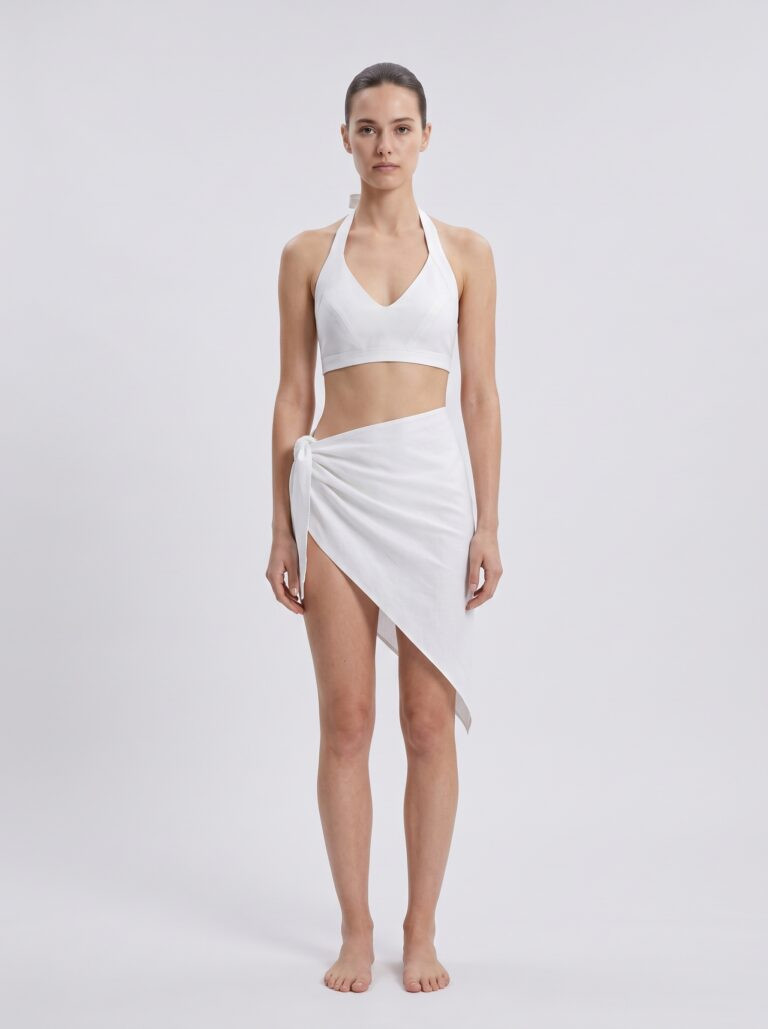 DYSW-403
Asymmetric tie pareo skirt
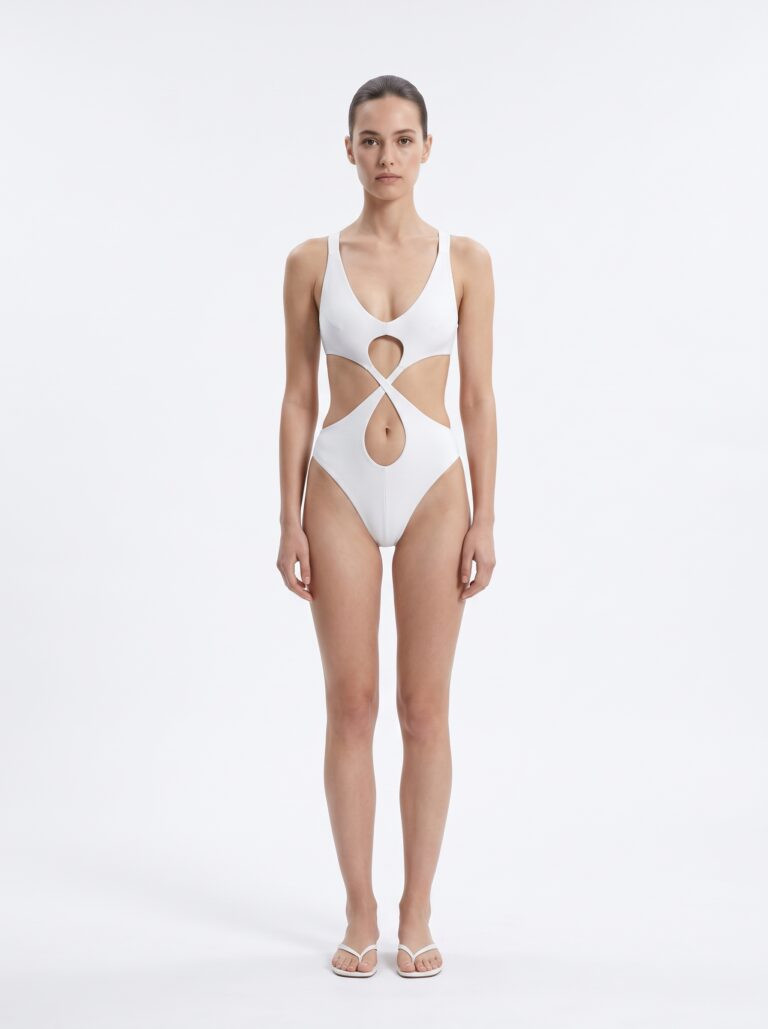 DYSW-135
One-piece swimsuit with figure-eight cut-outs
 DYSW-220
Sliding triangle bikini with tie strings
 DYSW-402
Asymmetric panel beach kimono
 DYSW-134
Plunging one-piece swimsuit with braided cords
 DYSW-219
Twisted bandeau bikini with high-cut bottoms
 DYSW-218
Ruffled bandeau bikini with ring
 DYSW-401
Long V-neck beach dress
 DYSW-133
One-piece swimsuit with spiral cut-outs and starfish
 DYSW-132
One-piece swimsuit with crossed cut-outs
Written at the D'YRSAN workshop in Asnières-sur-Seine, where we develop and produce our clients' collections: pattern making, prototyping, industrialization, small-batch production.
Tell us about your project→