The Journal / Brand development
Small-batch garment production: 9 points to check before manufacturing in France
Prototype, minimums, unit cost, lead times: the 9 points to check to succeed with your small-batch production at a French workshop.
10 November 2026 6 min read By the D'YRSAN workshop
Launching a small-batch sewing in France is today the choice of many designers who want to test a collection without tying up too much stock. You still need to find a workshop that accepts your quantities, understand what will drive your cost price, and know what to prepare before the first meeting.
In our Asnières-sur-Seine workshop, we support swimwear, lingerie and ready-to-wear brands, from pattern making through to production. Here are the 9 points to check to choose your manufacturer and produce with confidence, whether you are preparing your first collection or your third.
Preparing your file before approaching a workshop
1. A complete technical file
Before any small-batch sewing, keep in mind that a workshop can only price correctly what it understands. Your tech pack must bring together the flat front and back drawing, the main measurements, the materials, the notions and the desired finishes. The more precise it is, the more reliable the quote will be and the fewer surprises you will have when the invoice arrives.
If you only have a sketch, this is not a blocker: a design office can turn your intention into a industrial pattern. This is precisely the role of our design and prototyping office, which prepares the technical foundations before any production.
2. A prototype validated, worn and corrected
Never launch a run on a pattern that has not been fitted. The prototype is used to check the fit, the strength of the seams and the behavior of the fabric. Plan at least one fitting on a person matching your base size, then a second version if significant corrections are made.
Every correction made at this stage costs far less than an error reproduced across the whole run. Require an approved pilot sample and kept by both parties: it becomes the reference the workshop must respect piece after piece.
Workshop minimum order: what to ask for
3. The minimum per style, per color and per size
Visit workshop minimum order is not always expressed the same way. Some workshops reason by style, others by color, and still others by overall order. A run of fifty pieces spread over five sizes and two colors represents only five pieces per variant: explicitly ask how the minimum is calculated.
A small-quantity sewing workshop in France generally accepts volumes of a few dozen pieces, but the setup work remains the same whether you produce few or many. Compare quotes built on the same breakdown of sizes and colors, and attach this breakdown to your request a quote to obtain a realistic quote.
4. Minimums from your material suppliers
The workshop's threshold is only part of the equation. Fabric manufacturers often impose minimums by the meter or by the roll, sometimes greater than your actual needs. For small-batch sewing, fabrics available in stock are often more accessible than custom fabric developments.
Think about notions too: elastics, underwires, snaps, linings, labels. For your prototypes and your first runs, a haberdashery offering fabric by the meter and notions lets you buy the right quantities. Calculate the fabric consumption per piece, seam allowance included, before ordering.
Unit cost for small-batch production: how to break it down
5. What the price per piece really includes
A unit cost is made up of several items: cutting, assembly, finishing, pressing, inspection and packaging. Added to this are the fixed launch costs: marker making, machine setup and possibly grading. In small-batch sewing, these fixed costs weigh heavily, since they are spread across few pieces.
Ask for a detailed quote item by item rather than an overall price. You will then know where to act: simplifying a finish, reducing the number of pattern pieces or grouping two colors can lower the price without changing the identity of the garment. It is also the best way to comparing two garment manufacturers honestly.
6. Grading and size selection
Visit grading consists of grading the base pattern into all the sizes offered. It has a cost, and each additional size fragments your run. For a first launch in small-batch garment making, a tight range of three or four sizes is often more profitable than a full grade.
Rely on your data: pre-orders, customer feedback, past sales. A size distribution table per size, established before the quote, avoids producing unsold stock in the extreme sizes and running short of pieces in the core sizes.
Lead times and quality control in made-in-France textile production
7. A realistic schedule, from material to delivery
The lead time announced by a workshop rarely starts on the day of your first message. It depends on the receipt of materials, from prototype approval and the workshop's schedule, which serves several brands in parallel. A made in France textile production is closer and more responsive than distant manufacturing, but it requires anticipation.
Plan backwards from your release date: add the photo shoot, the online listing and the shipping of pre-orders. For small-batch garment making, book your production slot as soon as the prototype is on track, especially before busy periods such as spring for swimwear.
8. Quality controls and defect management
Ask the workshop how it checks the pieces: in-process checks during assembly, measurement check on a sample, final inspection before packing. A small-batch garment run tolerates few losses, since every defective piece weighs directly on your margin.
Clarify in writing what happens in case of a defect: alteration, replacement, accepted measurement tolerance. These rules, set from the quote onward, prevent misunderstandings and give you a clear framework to receive your order.
Choosing a specialized manufacturer for your small-batch sewing
9. The workshop's specialty and its transparency
A swimsuit, a bra and a jacket are assembled neither with the same machines nor with the same techniques. Stretch fabrics require stretch points, suitable cover-machines and great precision on tension. Corsetry requires mastery of boning, cups and fastenings.
Check, then, that the workshop knows your category: swimwear development, lingerie and corsetry or ready-to-wear require distinct expertise. Ask to see garments already made in your field and to visit the workshop if possible.
Finally, ask the workshop about its practices: origin of materials, offcut management, work organization. These elements will also feed your brand story. Our choices are detailed on the page dedicated to our commitments to responsible production. A lasting relationship is built on transparency and a reachable point of contact.
Small-batch sewing: moving forward step by step
Succeeding at small-batch garment making is above all about preparation: a clear technical file, a validated prototype, a thoughtful size grading and a schedule that leaves room to spare. Minimums, costs and lead times then become parameters you control, rather than obstacles.
Take the time to meet your garment manufacturer, understand their methods and ask all your questions before signing. To see what a specialized workshop brings, discover the expertise of our workshop. A first well-run series brings you far more than garments: a customer feedback, sales data and solid working relationship on which to build your upcoming collections.
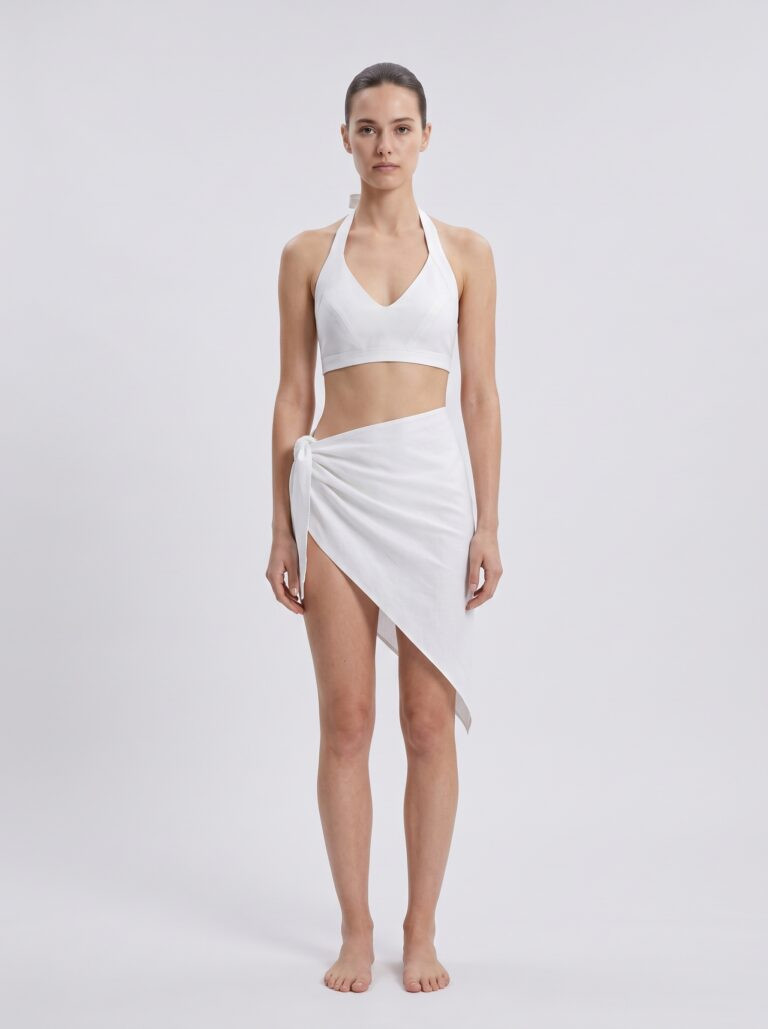 DYSW-403
Asymmetric tie pareo skirt
 DYSW-135
One-piece swimsuit with figure-eight cut-outs
 DYSW-220
Sliding triangle bikini with tie strings
 DYSW-402
Asymmetric panel beach kimono
 DYSW-134
Plunging one-piece swimsuit with braided cords
 DYSW-219
Twisted bandeau bikini with high-cut bottoms
 DYSW-218
Ruffled bandeau bikini with ring
 DYSW-401
Long V-neck beach dress
 DYSW-133
One-piece swimsuit with spiral cut-outs and starfish
 DYSW-132
One-piece swimsuit with crossed cut-outs
Written at the D'YRSAN workshop in Asnières-sur-Seine, where we develop and produce our clients' collections: pattern making, prototyping, industrialization, small-batch production.
Tell us about your project→