The Journal / Brand development
Mandatory garment label: the 8 mentions to check before selling
Composition, manufacturer, care, traceability: the 8 mentions to check on your garment labels before launching your first production run.
November 4, 2026 6 min read By the D'YRSAN workshop
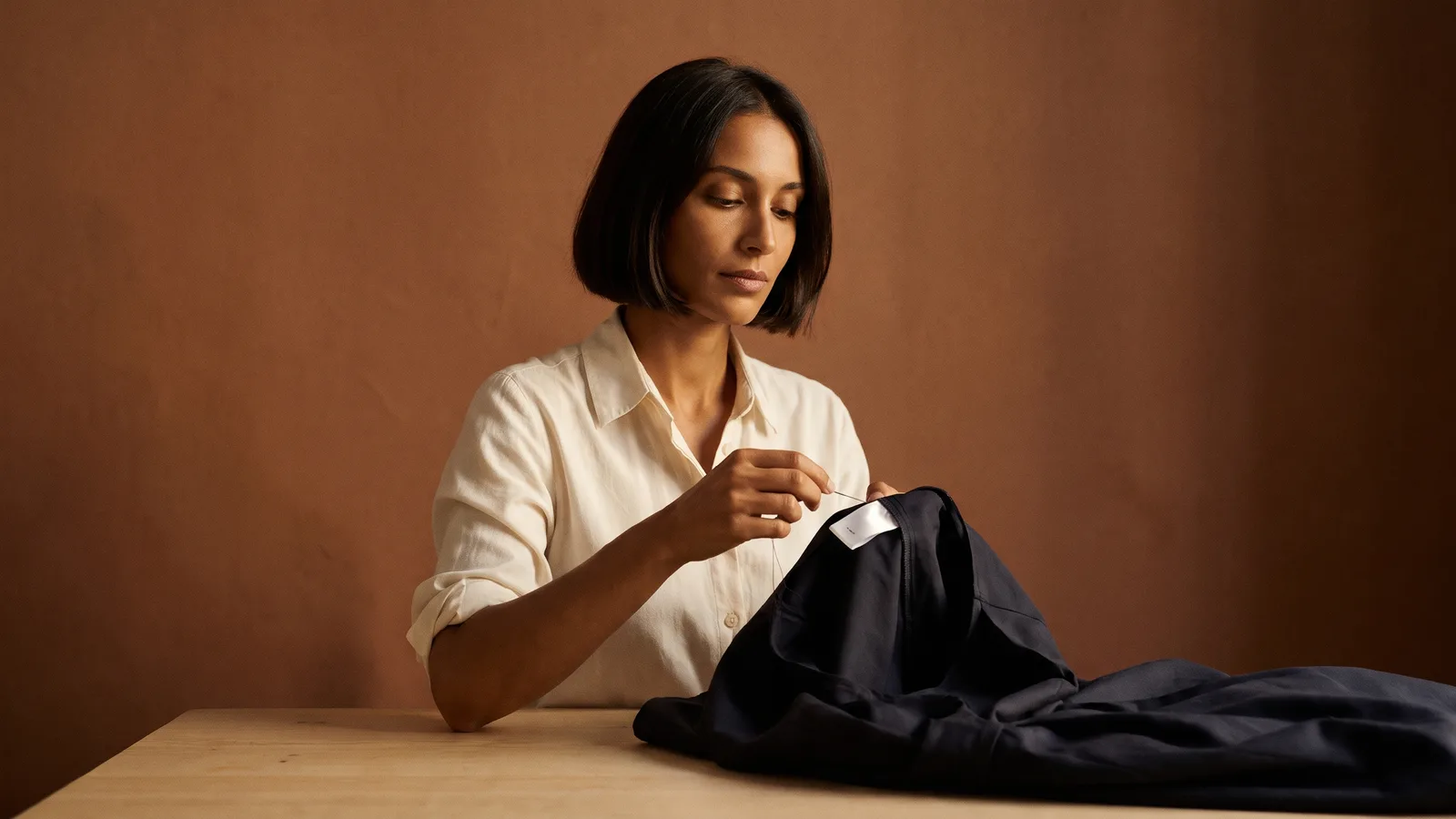
When launching your first production run, one question almost always comes up in the workshop: what should the’mandatory garment label sewn into every piece? Composition, care, manufacturer details, traceability… The rules have piled up in recent years, between the European regulation on textile names, the AGEC law and the new product safety regulation.
Good news: once the logic is understood, nothing is insurmountable. We have gathered the 8 mentions to be checked before selling, clearly distinguishing what the law requires from what practice makes unavoidable. This allows you to validate your labels before the launch of the series, and not after the first customer feedback.
Why the mandatory garment label commits your brand
In France, a textile garment sold to the consumer must indicate at minimum its composition, in French, in a legible and durable manner. The reference text is the Regulation (EU) No 1007/2011, supplemented by the Consumer Code and the law on the use of the French language. A missing or incorrect mention exposes you to inspections by the DGCCRF, and even to product withdrawal.
Beyond the risk, the mandatory garment label is a source of trust. It is often what a buyer looks at in store, even before the price. A precise, clean and well-placed label says a lot about the rigor of a young brand, especially with retailers who systematically check this point.
Textile composition: the two mentions required by the European regulation
1. The fiber composition
The fiber composition label lists each fiber by its generic name, with its percentage by weight, in descending order: «80% polyamide, 20% elastane» for a swimsuit, for example. Trade names of fibers never replace the official designation. The mention «100%» or «pure» is reserved for pieces made of a single fiber.
For a piece made of several components, such as a lined dress or a bra, the regulation requires stating the composition of each part of a different nature. Only components weighing less than 30% of the total weight are exempt, except for the main lining. In corsetry, where lace, tulle and foam come together, this is a point to anticipate from the development of your lingerie designs.
2. Non-textile parts of animal origin
If your garment includes leather, fur or horn, for example on a button or a fastening tab, the statement «Contains non-textile parts of animal origin» is mandatory. It is frequently overlooked on jackets and accessories. Think about it from the choice of trimmings, just like the fabric composition.
Identifying the manufacturer and the product: safety requirements
Since 13 December 2024, Regulation (EU) 2023/988 on general product safety applies to garments. It requires each product to be identifiable and clearly designates who is responsible in case of a problem.
3. The name and contact details of the manufacturer
The label, or failing that the packaging or an accompanying document, must indicate the name or registered trademark of the manufacturer, an postal address and a email address. For a brand that outsources production, this is in principle the one listed as manufacturer, since it places the piece on the market under its name. A brand established outside the European Union must also designate a responsible person within the EU.
4. A reference, a lot or a serial number
The product must also carry an identification element : model reference, lot or serial number. A reference such as model-colorway-season is often enough, provided it allows you to trace the production concerned. It is the key to any recall, and a real inventory management tool.
Care, size, origin: three mentions that practice requires
These three pieces of information are not all strictly mandatory by law. But no serious brand goes without them, and some become binding as soon as you display them.
5. The garment care label
In France, the garment care label is not required by any specific text. It remains expected by customers and retailers alike, and protect your brand in case of a dispute over a garment damaged in the wash. Use the five standardized symbols (washing, bleaching, drying, ironing, professional care), in that order, and validate them through tests on the actual fabric.
6. The size
No rule imposes a single sizing system, but a garment without a size cannot be sold. Choose a system (36, 38… or S, M, L) and apply it consistent across the entire collection, with an online size guide. In swimwear, questions of support and cup fit are settled from the swimwear development.
7. The country of origin
The «Made in…» marking is not not mandatory within the European Union. However, if it appears on the label, it must be accurate: a garment is deemed to originate from the country of its substantial last transformation, in practice garment making. A misleading origin claim constitutes an unfair commercial practice.
AGEC law for textiles: traceability and sorting instructions
The 2020 AGEC law, specified by an April 2022 decree, adds an eighth family of information, focused on the environment. It applies gradually depending on the turnover and the number of pieces placed on the market: small brands are not all subject to it yet, but have every interest in anticipating it.
8. Environmental qualities and textile traceability
For brands concerned, the product sheet must indicate, in digital form, the countries of the main stages: weaving or knitting, dyeing and printing, garment making. Added to this are any share of recycled materials and, above 50% synthetic fibers, the statement «Releases plastic microfibers into the environment during washing.» This data complements the mandatory garment label without replacing it.
Regardless of these thresholds, garments fall under a extended producer responsibility : the brand joins the sector's eco-organization and displays the sorting symbol, the Triman logo accompanied by the sorting information. The law also prohibits vague claims such as «biodegradable» or «environmentally friendly.» Solid textile traceability is built with your suppliers, in the spirit of our commitments to responsible production.
Making a mandatory garment label that is legible and durable
A correct mention is useless if it fades after the third wash. The label must be securely attached, legible and accessible : in practice, a woven or satin-printed label, sewn into the seam on the side or at the center back. Test its wash resistance just like the fabric, and check that it does not itch, especially on a piece worn directly against the skin.
Keep the roles separate too. The brand label, visible at the neckline, reflects your identity and is developed with your branding strategy. The regulatory label can sit more discreetly, in the form of a multi-page booklet if the piece is complex. For swimwear, choose a fabric that withstands chlorine and salt water.
Finally, build labeling into the technical file from the prototype stage : composition confirmed, care symbols tested, placement noted on the spec sheet. This is how the’workshop and its design office can place the mandatory garment label in the right spot, across the entire run, with no last-minute rework.
An accurate label, the first sign of professionalism
Remember the basic rule: the composition and the contact details of the person responsible are non-negotiable, care and size are expected from every piece, and the origin and AGEC information commit your word as soon as you display them. Have your labels proofread before approving production and keep the fabric supporting documents for each reference.
Whether you are developing a ready-to-wear or a swimwear line, these checks naturally fit into the request a quote, when the notions are set. A well-planned mandatory garment label barely gets noticed: that is precisely what signals a well-controlled garment.
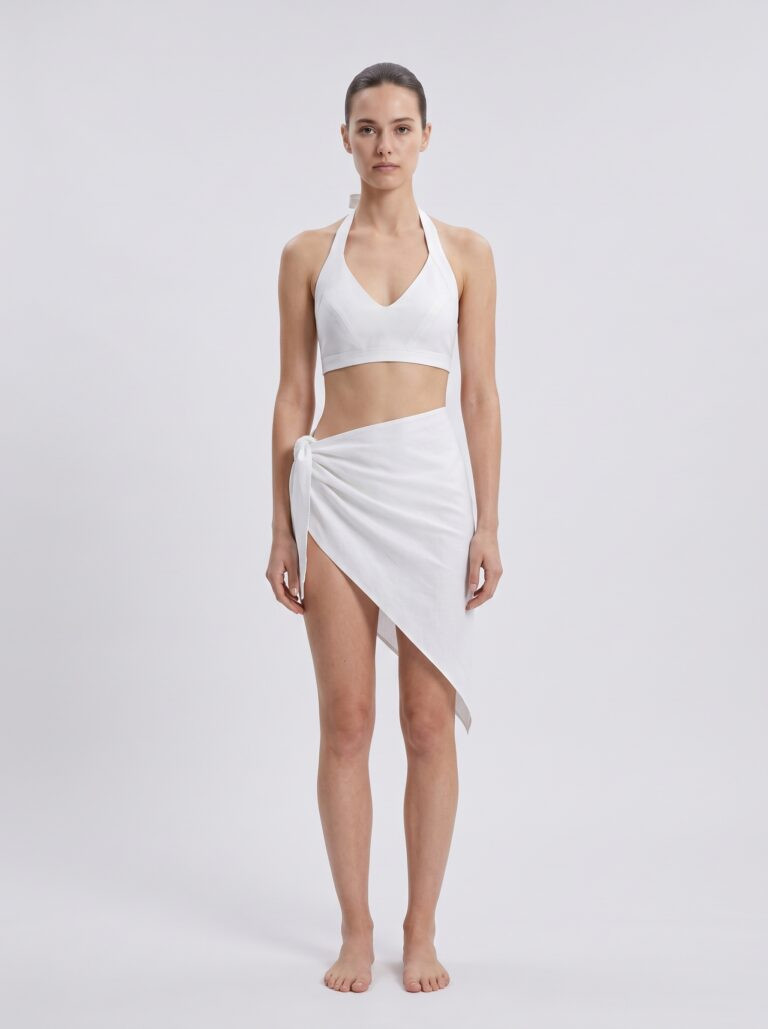 DYSW-403
Asymmetric tie pareo skirt
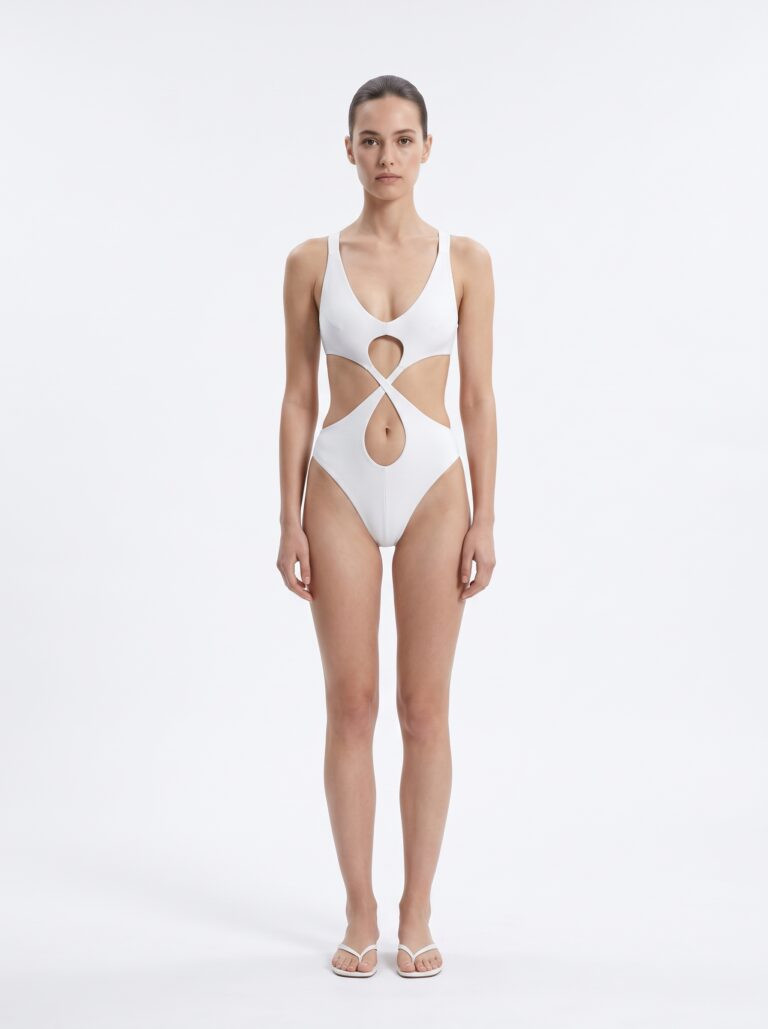 DYSW-135
One-piece swimsuit with figure-eight cut-outs
 DYSW-220
Sliding triangle bikini with tie strings
 DYSW-402
Asymmetric panel beach kimono
 DYSW-134
Plunging one-piece swimsuit with braided cords
 DYSW-219
Twisted bandeau bikini with high-cut bottoms
 DYSW-218
Ruffled bandeau bikini with ring
 DYSW-401
Long V-neck beach dress
 DYSW-133
One-piece swimsuit with spiral cut-outs and starfish
 DYSW-132
One-piece swimsuit with crossed cut-outs
Written at the D'YRSAN workshop in Asnières-sur-Seine, where we develop and produce our clients' collections: pattern making, prototyping, industrialization, small-batch production.
Tell us about your project→