The Journal / Brand development
Swimwear Design: The 7 Steps in the Workshop, from Sketch to Approved Prototype
Brief, sketch, pattern making, prototype, fitting: the 7 steps of swimwear design in a design studio, through to the approved model.
November 26, 2026 6 min read By the D'YRSAN workshop
Visit swimwear design follows a precise path in the design office: brief, technical sketch, choice of fabrics, pattern making, prototype, fitting, then adjustments and grading. These seven steps turn a drawn idea into an approved prototype, ready to be produced in series without unpleasant surprises. Each answers a constraint specific to swimwear: a stretch fabric, a garment worn close to the body, wet, that must hold up in motion.
At the Asnières-sur-Seine workshop, we support designers launching their first line as well as brands expanding their range. November is often the decisive month: summer prototypes must be approved before winter to leave time for production. Our page dedicated to swimwear design and manufacturing for brands presents the whole support; here, in detail, is what happens at each step.
Steps 1 and 2 of swimwear creation: the brief and the technical sketch
Step 1: a brief that says it all
Everything starts with a discussion about your collection: target, use, level of support, targeted size range. A designer swimwear designed for the poolside does not have the same requirements as a one-piece meant for swimming. Also specify your price positioning : it guides the choice of fabrics and the number of sewing operations. The more precise the brief, the fewer back-and-forths there will be.
Step 2: from the mood sketch to the technical drawing
Your inspiration sketch conveys the intention. The design office translates it into a flat technical drawing, seen from front and back, with every seam, every elastic, every topstitch. This drawing becomes the basis of the tech pack : strap width, armhole depth, type of closure, placement of linings.
This is the stage where tricky points are identified: a plunging neckline without underwire, a very deep back, a tied strap that must stay stable. Note your priorities directly on the sketch, distinguishing what is non-negotiable from what can evolve. These indications guide all technical decisions in the following steps.
Step 3: choose the fabrics and notions before pattern making
In swimwear design, you never pattern before having the fabric. The most common fabric combines polyamide and elastane, in proportions that vary according to the support sought. Its stretch rate, measured in length and width, directly determines the pattern dimensions. Changing fabric afterward almost always means redoing the pattern making.
Notions matter just as much: special swim elastic resistant to chlorine and salt, lining, molded cups, rings and sliders in treated metal or resin. An unsuitable component yellows, oxidizes or loses its stretch after a few swims. Whether you go through your own swimwear supplier or through our haberdashery of fabric by the meter and trims, always ask for the composition and performance sheets.
Practical tip: plan for a few meters extra than needed for the prototype. They are used for wash, opacity and color fastness tests, before you commit to a production yardage.
Step 4: pattern making, the technical core of swimwear design
A swimsuit pattern does not look like a dress pattern. It is built in negative ease : its measurements are smaller than the body's, so that the stretched fabric fits the silhouette. The pattern maker applies a reduction coefficient calculated from the stretch of the fabric, different in height and width.
It starts from a proven base, bottoms, triangle top or one-piece, which is transformed according to your design: shifted cut lines, rise height, back depth. The seam allowances are reduced and elastic placements are planned from the pattern. Everything is decided to the millimeter at the crotch and armholes.
The pattern is made from a single base size, that of the person who will do the fitting. We do not grade yet: there is no point in scaling a model that is not yet approved. To see how our design and patronage office, the workshop presentation details our methods.
Steps 5 and 6: from the swimsuit prototype to the fitting
Step 5: sew the first prototype
The first swimsuit prototype is sewn in the final fabric, or in a fabric with identical stretch if the color is not yet available. We use the production machines: four-thread overlock for assembly, coverstitch or zigzag stitch to attach and turn the elastics. The prototype thus reveals assembly difficulties, not just the shape.
This step also helps estimate the time for each operation and anticipate the cost of manufacturing. A detail that looks appealing on paper but is long to sew should be simplified now, rather than during full production.
Step 6: the fitting on a real person
A foam bust is not enough for swimwear. The fitting is done on a living person, who sits down, raises their arms, bends over, walks. We observe bust support, the hold of the leg elastic, creasing at the crotch and the riding up of the bottom during movement.
Think about the wet test, a decisive step in any swimwear design: a dry swimsuit and a soaked one do not behave the same way. Water weighs down the fabric, reveals sheerness and air pockets. Each remark is noted, photographed and transferred to the tech pack.
Step 7: adjustments, grading and approval of the swimwear design
It is rare for a first prototype to be approved as is. The number of versions depends on the complexity of the style : a simple triangle converges quickly, while a structured one-piece with cups requires more back-and-forth. Each correction is transferred on the pattern, never on the garment alone, to keep a reliable reference.
Once the base size is approved comes the grading : the pattern is extended across the full size range. Differences are not linear everywhere: the crotch and cups change differently from the hip measurement. A fitting on the smallest and largest sizes is strongly recommended.
Validation is formalized by a reference prototype, accompanied by the final tech pack and graded pattern. This trio serves as the basis for production, whether a small run or a larger volume. For quantities, see our article on minimum order quantities at garment workshops answers frequently asked questions.
Mistakes that lengthen a swimwear design
- Choosing the fabric too late : the entire pattern depends on its stretch.
- Multiplying styles from the first collection: three well-resolved styles are better than ten approximate ones.
- Validating without a wet test : the transparency of a light shade often only appears in water.
- Neglecting notions: a standard garment elastic loses its shape on contact with chlorine.
- Comparing workshops on price alone: mastery of stretch materials shows from the very first prototype.
On this last point, our guide to choosing a swimwear manufacturer in France details the criteria to check before entrusting your development.
Succeeding at swimwear design: what to remember
A successful swimwear design relies on a method: a clear brief, a material chosen early, a negative-ease pattern fit, and fittings in motion then wet. The seven steps may seem numerous, but each one avoids a costly defect in production.
If you are prototyping this winter for summer, validate your materials now and allow time for several fittings. Details of our support, from sketch to production run, are on our dedicated page on swimwear design and manufacturing. A well-validated prototype means a collection that goes into production with confidence.
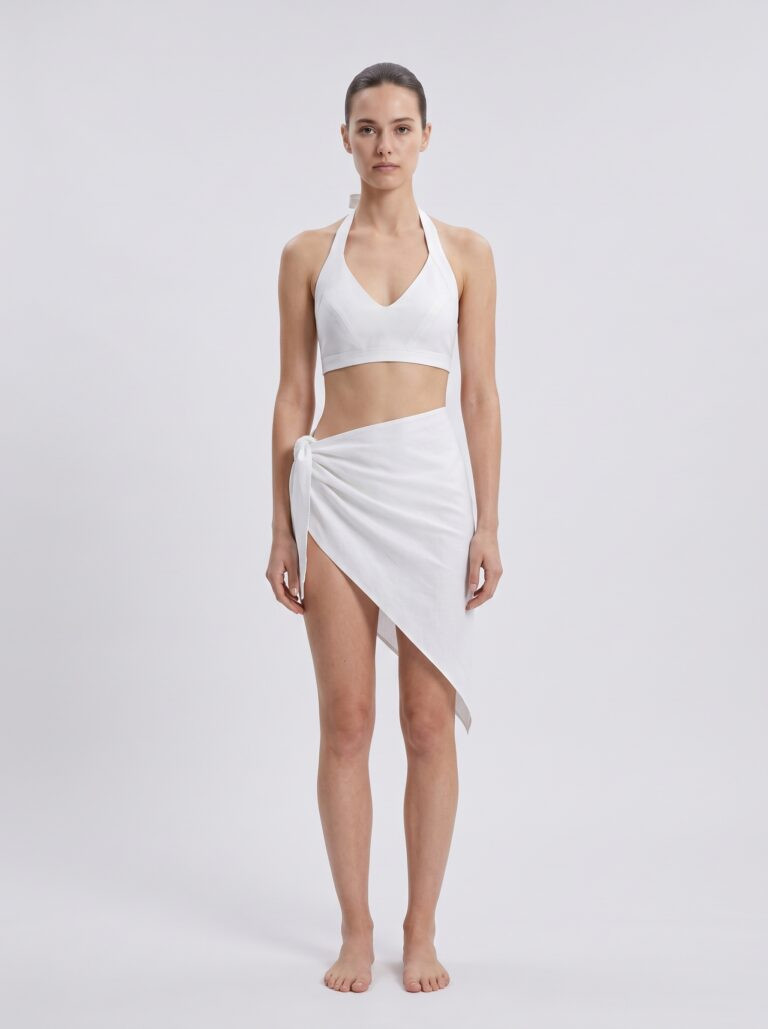 DYSW-403
Asymmetric tie pareo skirt
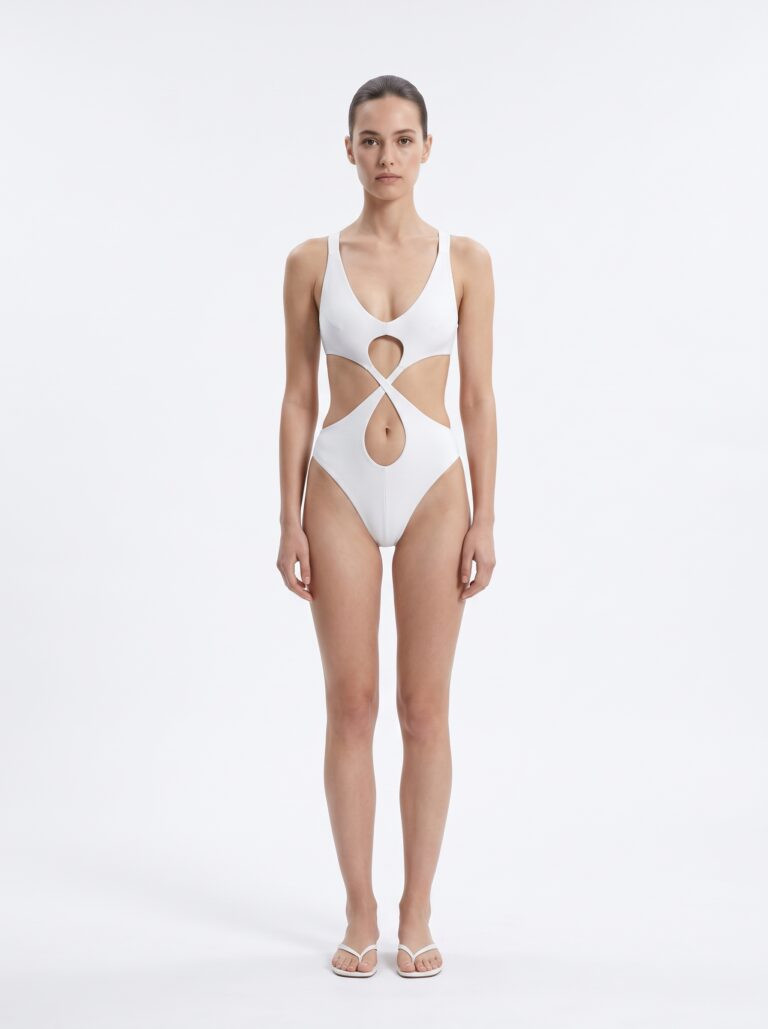 DYSW-135
One-piece swimsuit with figure-eight cut-outs
 DYSW-220
Sliding triangle bikini with tie strings
 DYSW-402
Asymmetric panel beach kimono
 DYSW-134
Plunging one-piece swimsuit with braided cords
 DYSW-219
Twisted bandeau bikini with high-cut bottoms
 DYSW-218
Ruffled bandeau bikini with ring
 DYSW-401
Long V-neck beach dress
 DYSW-133
One-piece swimsuit with spiral cut-outs and starfish
 DYSW-132
One-piece swimsuit with crossed cut-outs
Written at the D'YRSAN workshop in Asnières-sur-Seine, where we develop and produce our clients' collections: pattern making, prototyping, industrialization, small-batch production.
Tell us about your project→