Calculating clothing retail price: the 6-step method and the right coefficient for your brand
Cost price, coefficient, wholesale and retail prices: the 6-step workshop method for setting profitable and consistent prices.
October 24, 2026 6 min de lecture Par l’atelier D’YRSAN
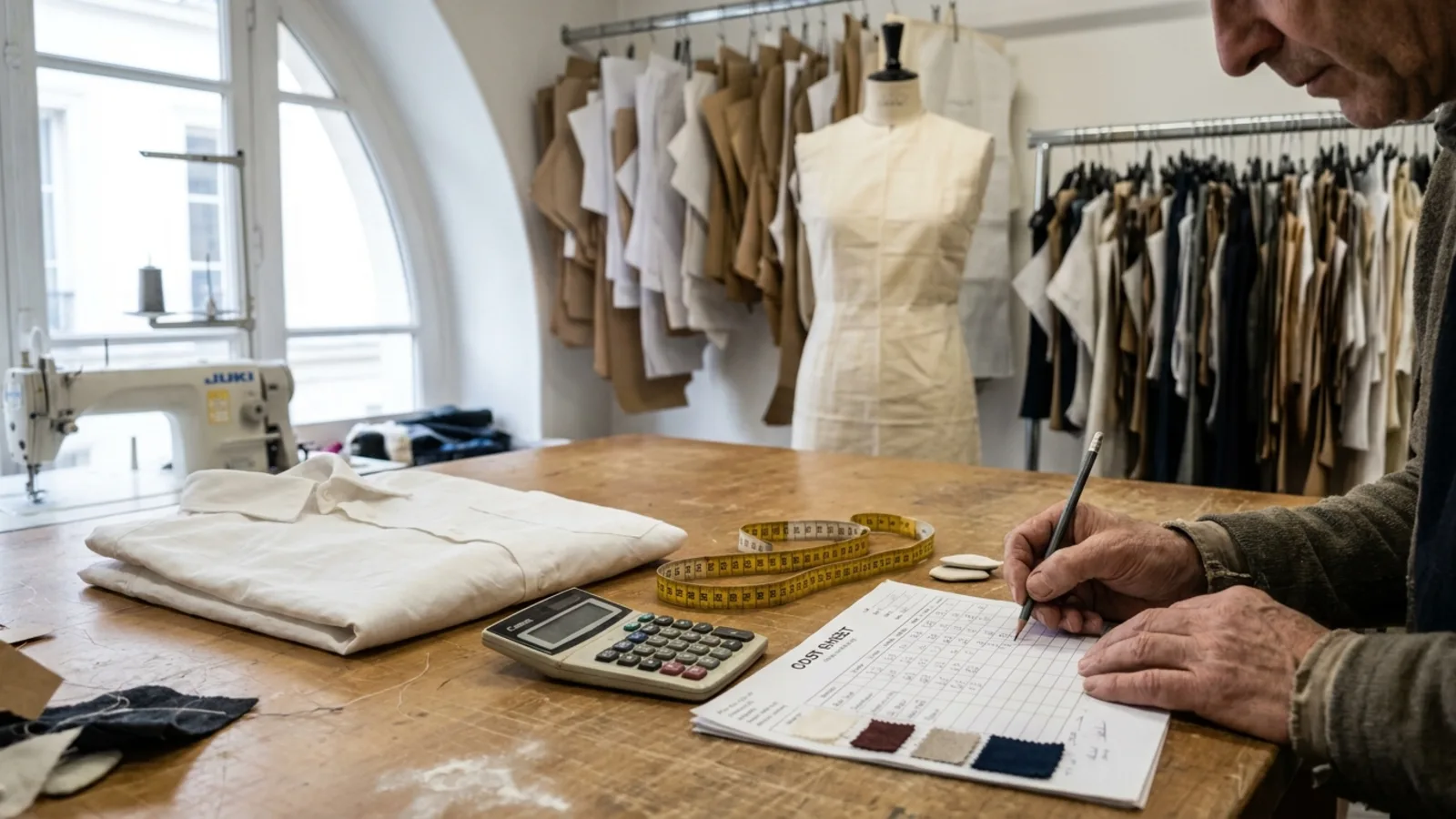
You've approved your prototypes, and one question keeps coming up: how do you calculate the selling price of clothing without sacrificing your profit margin or discouraging your customers? This is one of the most frequent requests we receive at the workshop. It deserves better than a randomly chosen coefficient, because a poorly calculated price can weaken a brand that is otherwise desirable from its very first collection.
This article offers you a 6-step method, of cost price at the price displayed in the store. It does not take into account the overall budget of a capsule collection: it focuses on the piece, unit by unit, so that each model is profitable regardless of your sales channel.
Before calculating clothing selling price: five concepts to distinguish
Visit clothing production cost This includes the cost of manufacturing a part: materials, supplies, and manufacturing process. clothing cost price It goes further and includes the additional costs associated with each unit: development amortization, labels, packaging, transport. This second figure serves as the basis for all calculations.
Visit multiplier coefficient is the number by which you multiply a cost to obtain a price. The margin is the difference between this price and this cost, expressed in euros or as a percentage. Finally, we must separate the wholesale price, sold excluding VAT to shops, and the retail price, displayed including VAT to the consumer.
Confusing these concepts is the primary source of error. A 50% markup on the selling price does not correspond to a coefficient of 1.5 but to 2. If you reason in percentages without checking, you systematically undervalue your prices.
Steps 1 to 3: Establish the cost price of each part
Step 1: Estimate the cost of materials and supplies
Start with the technical specifications and list each component: main fabric, lining, interfacing, threads, buttons, zipper, elastic. For the fabric, multiply the consumption per meter resulting from the placement by price per meter, then add 5 to 10 % loss for defects and drops. If you source your supplies from our online haberdashery, Note the unit price of each item.
Step 2: Integrate the cost in a way
The labor cost covers cutting, assembly, finishing, and quality control. It depends on the complexity of the design, the number of operations, and especially the quantity: a small series costs proportionally more than a production run of several hundred pieces. Always ask for a quote. by series size, for example in requesting a detailed quote which specifies your quantities.
Step 3: Allocate the additional costs
Pattern making, grading, prototypes: these development costs are incurred once, but must be amortized on the series. Divide their total amount by the number of units planned to obtain a cost per unit. Then add composition labels, brand label, packaging, and shipping costs.
The work carried out beforehand by a design and patronage office This directly impacts the calculation. An optimized pattern reduces fabric consumption and assembly time, two factors that affect each garment.
Let's take a fictional example of a shirt: €14 for materials and supplies, €22 for manufacturing, and €6 for miscellaneous expenses. Its cost price is €42 excluding VAT. This figure will serve as our guiding thread for what follows.
Steps 4 and 5: Calculate the clothing selling price using the correct coefficient
Step 4: Set your wholesale price
If you sell to shops, your wholesale price is obtained by applying a coefficient, generally between, to the cost price. 2 and 2.5. This coefficient covers your fixed costs (salary, trade shows, photos, website) and determines your profit. With our €42 shirt, a coefficient of 2.2 gives a wholesale price of approximately €92 excluding VAT.
Step 5: Deduce the retail price
The shop, in turn, applies its own markup, often located between 2.2 and 2.8 The price is calculated on the pre-tax purchase price to obtain the price including tax. Our shirt thus retails for around €210. This retail price must remain the same on your website: selling for less online than in-store damages your relationship with your retailers.
In direct sales, many brands retain a overall coefficient of 4 to 5 between cost price and price including VAT. The difference compared to the retail channel isn't a bonus: it finances advertising, payment processing fees, returns, and shipping. To calculate the selling price of clothing for direct sales, think as if you were your own retailer.
Step 6: Compare the price to your positioning
Knowing how to calculate clothing selling prices isn't enough: a calculated price isn't necessarily a fair price. Note the prices of ten to fifteen comparable brands by style, material quality, and place of manufacture. If your result is significantly above, look for ways to reduce costs; if it's significantly below, you're probably leaving room for improvement.
The price also contributes to your image. A piece made in France, in small batches, with traceable materials, justifies a higher price provided the client understands it. Your brand identity and your speech on manufacturing, like our responsible production commitments, make this price legible.
Finally, consider the psychological thresholds €195 or €199 do not produce the same effect as €210. Round up by measuring the impact on your margin, and check the consistency of your product range : a top shouldn't cost almost as much as a jacket.
Adjust the mode multiplier coefficient according to your category
Not all products support the same coefficient. lingerie and corsetry, The number of components (underwires, straps, clasps, laces) and the precision of the assembly increase the cost price: the markup often needs to be adjusted to remain competitive. Our page dedicated to lingerie development details these specific features.
In swimsuit, Fabric consumption is low, but technical materials, linings, and durability testing account for a significant portion of the cost. Seasonality also plays a role: an unsold model at the end of summer ends, This argues for a slightly more comfortable coefficient. swimwear development These parameters are integrated from the prototype stage.
In ready-to-wear, The solution often lies in reasoning in average collection coefficient. A basic item sold in volume with a moderate markup can compensate for a more expensive, high-value item to produce. The key is that the overall profit margin holds up.
Mistakes that weaken a clothing brand's profit margin
Certain errors recur in almost every collection plan we see. Identifying them before calculating clothing retail prices prevents you from having to adjust your prices after the launch, which is always a delicate matter with your customers and retailers.
- Forget about your own salary : the time spent on creation, communication and sales must be included in your fixed costs.
- Ignore sales and discounts : if a significant portion of the stock is sold at a reduced price, your actual margin drops accordingly.
- Calculate on a optimistic quantity : amortizing development costs over 300 units when you will only sell 100 throws off the whole calculation.
- Neglecting returns and unsold items: in online sales, they represent a real cost to be budgeted for.
- Confusing pre-tax and post-tax amounts : the VAT of 20 % does not belong to you, it must be deducted before measuring your margin.
Calculating clothing selling prices: an exercise to repeat with each collection
The method consists of a simple chain: cost price, wholesale coefficient, retail coefficient, then market comparison. To reliably calculate clothing selling prices, each link in the chain must be based on real figures and not based on estimates.
Your prices will fluctuate with your volumes, materials, and sales channels. Keep a calculation table by model and update it as soon as a quote changes. More guidance on building a collection awaits you in the workshop journal. A well-structured price is not a constraint: it is what allows your brand to last beyond its first collection.
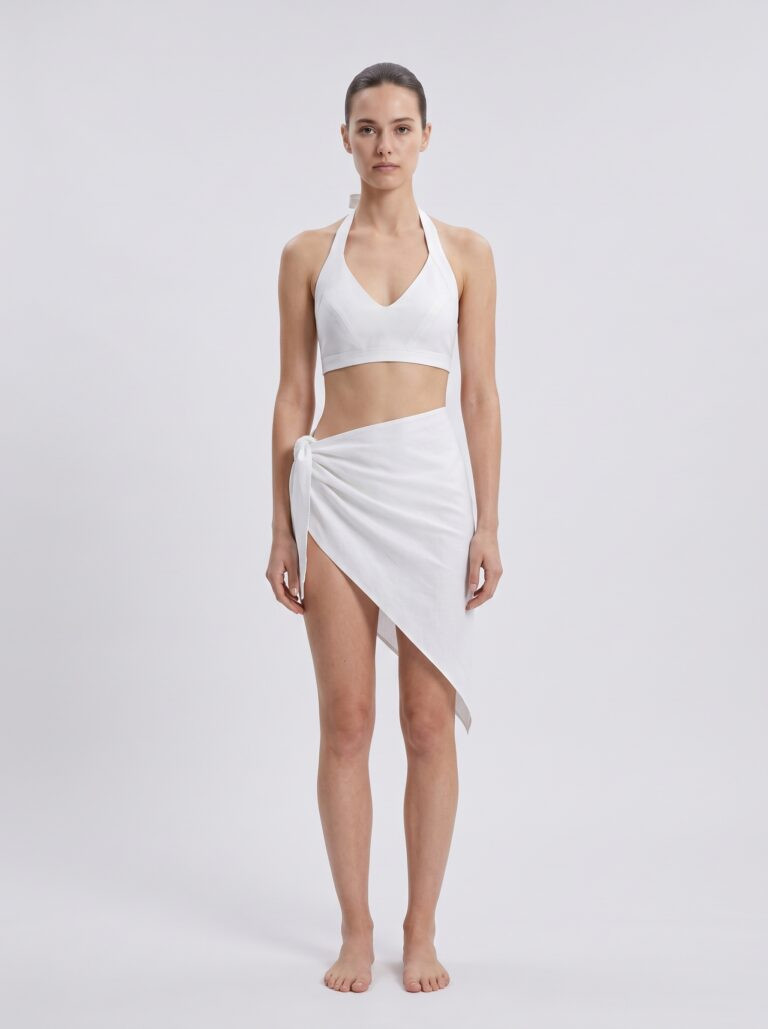 DYSW-403
Asymmetric tie pareo skirt
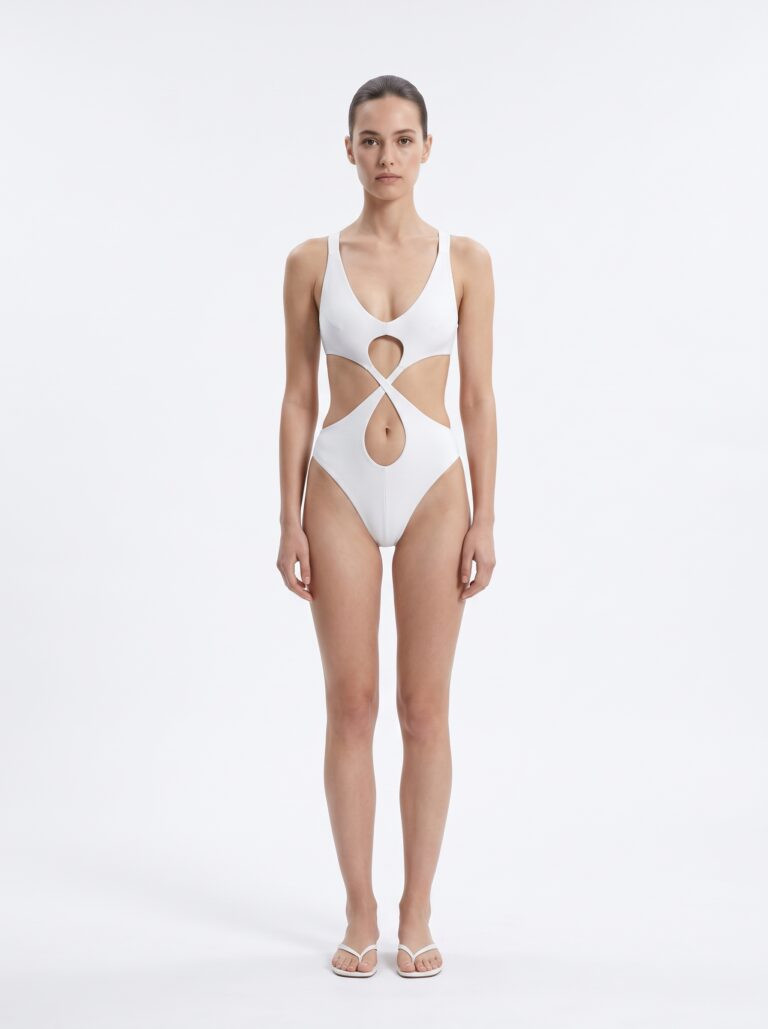 DYSW-135
One-piece swimsuit with figure-eight cut-outs
 DYSW-220
Sliding triangle bikini with tie strings
 DYSW-402
Asymmetric panel beach kimono
 DYSW-134
Plunging one-piece swimsuit with braided cords
 DYSW-219
Twisted bandeau bikini with high-cut bottoms
 DYSW-218
Ruffled bandeau bikini with ring
 DYSW-401
Long V-neck beach dress
 DYSW-133
One-piece swimsuit with spiral cut-outs and starfish
 DYSW-132
One-piece swimsuit with crossed cut-outs
Écrit à l’atelier D’YRSAN, à Asnières-sur-Seine, où nous développons et produisons les collections de nos clients : patronage, prototypage, industrialisation, production petite série.
Parler de votre projet→